Showing posts with label flower. Show all posts

Tuesday, May 5, 2020

The humble hibiscus

I have always looked at the hibiscus flower as a humble one, though I don't know why so. It is quite an attractive flower, does not require any extra inputs for flowering so liberally, and the flowers, the leaves are super beneficial for us - be it as a natural shampoo, for making hair oils, or making super tasty hibiscus flower juices.

I remember my childhood when we kids used to collect the flowers and feed them to the calf which relished and would consume them and would allow us to caress it.  Even cows love hibiscus flowers very much.

Collecting these flowers for the Onam (one of the key festivals of Kerala -India) floral circles called Pookkalam was a craze as these flowers are available in plenty and would make multiple circles with hibiscus flowers of different colours. Sometimes, when flowers are scarce, we even collect the leaves and make a green circle though it was considered among children as cheating.

So I still don't know why I consider this being a "humble" flower.

But look at it again, don't you also feel like it is a humble flower?

Tuesday, June 27, 2017

Moringa or Drumstick Tree: : Backyard nutrition ...

The drumstick tree is a common sight in most parts of India, especially in South India. Every household, you could see a drum stick tree, especially in villages. They have beutiful small white flowers, and long fruits which are the basic ingredient in the mouth watering South Indian Sambar and finds also its place in other recipes like Aviyal etc.
Its leaves are also edible and one can make innumerable curries with its leaves, or chutneys with garlic, ginger, green chillies etc (some times also called thuvayal in Tamil.

Those days, when you have mouth ulcers, when Vitamin B complex capsules or tablets were difficult to procure (especially for those in villages), a handful of its leaves is chewed or you make a Poriyal (Tamil) or Thoran (Malayalam), you are assured of immediate relief.  The flowers are also a delicacy and rich in nutrients and vitamins. The drumstick leaves are known to have high levels of Calcium, Iron, Magnesium and Manganese and many more minerals other than Vitamin A, B and also C.

Now the trees have started to flower everywhere in Pondicherry and you can see long tender fruits (the drum sticks) emerging . as bunches. One can also see a heightened increase in the awareness about this humble tree as urban elites have started buying drum stick leaf extracts and powder in online shops.  For the rural people, it is a ready-made vegetable at their backyard which can be harvested anytime.


The leaves being rich in Calcium and iron, this is a must include the diet of all women, especially mothers who breastfeed their kids. Consumption of drum stick leaves have to found to have good impact on the yield of breast milk and one can get away from the so called baby foods which actually do more harm than good.  So next time you see a drumstick tree, get a small cutting or get a seed from a dried fruit in your back yard or in a large HDPE bag so that you need not store those coloured vitamin tablets anymore..

Another interesting use of the drumstick seeds is in the purification of turbid water. When crushed moriga seeds are mixed with turbid, impure water, it clarifies the water which can be boiled and drunk. This is part of a traditional knowledge system in many parts of India. Anyhow, traditional knowledge also tells us that one must not consume the leaves during rainy season, possibly due to its high fibre content could create problems for our gut. 

Monday, September 1, 2014

Gliricidia flowers...

Gliricidia is a common tree species which was introduced into India for green leaf manure I suppose. I dont see many cows have a liking for this though it is also considered as a fodder. 


From wikipedia.(http://en.wikipedia.org/wiki/Gliricidia_sepium) 

The tree is used in many tropical and sub-tropical countries for various purposes such as live fencing, fodder, coffee shade, firewood,[4] green manure and rat poison.[5] Live fences can be grown from 1.5 m to 2.0 m stakes of Gliricidia sepium in just a month. Gliricidia can be intercropped with maize. Its effect is that of a potent fertilizer.[6][5]

Because it fixes nitrogen in the soil, it boosts crop yields significantly without the expense of chemical fertilizers. In addition, it tolerates being cut back to crop height year after year. The trees go into a dormant state when they are cut back, so the root system is not competing straight away for the nutrients, and the crop is free to become established. The trees only really start to come out of the dormant phase when the crop is already tall

G. sepium is also used for its medicinal and insect repellent properties. Farmers in Latin America often wash their livestock with a paste made of crushed G. sepium leaves to ward off torsalos. In the Philippines, the extract obtained from its leaves is used to remove external parasites.[2]
G. sepium is a fast-growing ruderal species that takes advantage of slash and burn practices in its native range. Its swift propagation has caused it to be considered as a weed in Jamaica.[3] Because it is easily propagated and grows quickly, it has also been suggested that this species may be planted to reduce topsoil erosion in the initial stages of reforesting denuded areas, an intermediate step to be taken before introducing species that take longer to grow.

Tuesday, July 29, 2014

Wordless Wild Beauty...


Seen everywhere...
Growing wild...
Such tiny flowers...
Wordless Wild Beauty...
(Lantana flower)...

Tuesday, July 14, 2009

Vinca Rosea or Periwinkle


This is a medicinal plant. Its alkaloids are hypotensive, sedative and have tranquilising properties and are anti cancerous. It helps in relieving muscle pain, depression of central nervous system and wasps stings.


It is called as Nithyakalyani in Malayalam. The active ingredients of this plant are used for a variety of allopathic drugs and ayurvedic drugs especially for the treatment of hypertension and for neuro medicine. It comes with different colours and also sometimes as mix of two or three colours.

Monday, July 6, 2009

Coquelicot Flowers


This is the Coquelicot Flower which I happen to fall in love while in Paris in the last week of June 2009. The French pronounce it as Ko-kli-ko. It looks like a poppy flower with red and a tinge of orange and is seen growing wild all over the railway tracks and country side. The lighting was not good and I could manage only this photo.

Thursday, April 30, 2009

Rangoon Creeper


This is Rangoon Creeper or Quisqualis indica. We used to have this in our ancestral house and one portion of our Mangalore tiled portico was completely covered with this plant like a curtain! I dont know what is the local name of this plant, but we used to call it Madras Mulla then.

The flowers change their colours from white to pink and then red and has a nice fragrance too.

Apparently this plant has some medicinal properties too which I learnt only now. The plant is used for traditional medicine like Decoctions of the root, seed or fruit can be used as anti-helmintic or for alleviating diarrhea. Fruit decoction can also be used for gargling. The fruits are also used to combat nephritis. Leaves can be used to relieve pain caused by fever. The roots are used to treat rheumatism. But be careful before you try anything of these, as dosages, concentrations are very important for ayurvedic or plant based medicines.

Friday, April 24, 2009

Hibiscus - a common flower and some interesting facts!

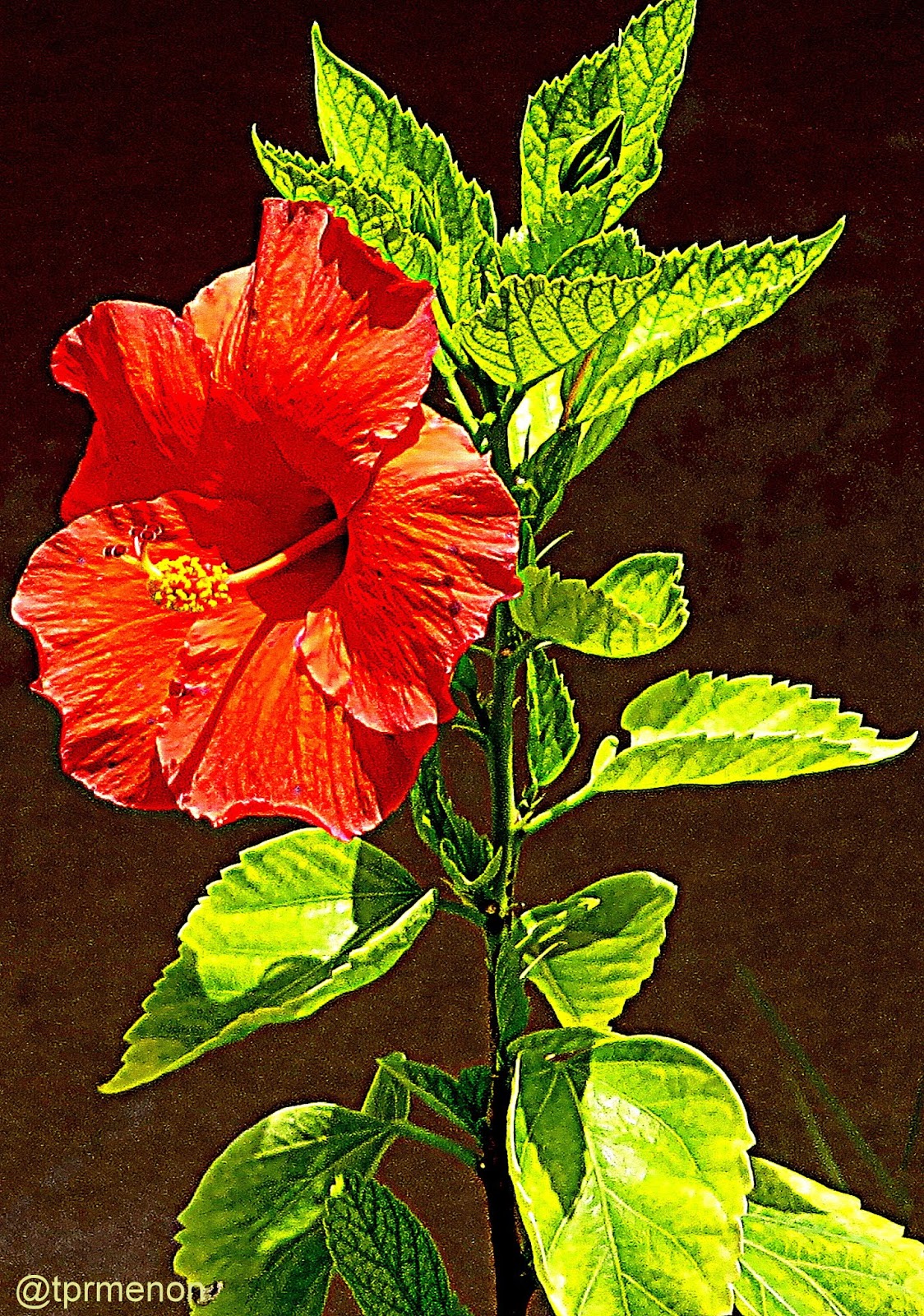
Today I thought I will write about the common Hibiscus flower which are so common to most of us. There are varieties and varieties of hibiscus with different colours, different petal arrangements and so on. Here is the photo of a flower from our own mini-garden!


Now some interesting facts about the flower. This is used as flower, a vegetable, a herb, a cosmetic and what not! The vegetable roselle is a hibiscus variety and is used in South India for making chutneys, pickles and even curries. Hibiscus juice is another attraction where hibiscus flowers are immersed in lemon juice and processed to get a very tasty juice concentrate!. Women use hibiscus leaves and flowers for hair-care by making a shampoo of it and this is a natural treatment for hair fall and dandruff. Just pick a handful of leaves and a few flowers and scrub on a rocky surface (usually ponds are lined with rocky plates in Kerala) with a bit of water and you get a rick, bubbling shampoo. It is no-cost and healthy too. Again petals of hibiscus are used in treatment of fever and its roots have properties which cure cough. Dieters or persons with kidney problems often take it without adding sugar for its beneficial properties and as a natural diuretic. It is made by boiling the dehydrated flowers in water; once it is boiled, it is allowed to cool and drunk with ice. So go home and make some hibiscus juice right away!

Hibiscus flowers have also other values. The red flowers are offered the Goddess of Kali and Ganesh. As kids, we used to remove the petals from the flower and then blow through the tiny openings at the base of the petal and the petal will blow up a bit like a balloon. It seems children in Philippines make bubbles with hibiscus flower and leave extraction by blowing into the solution by using hollow papaya stalks.

Now some humour also. Wearing a single hibiscus flower on only one of your ears is symbol of being a lunatic person in Kerala (India). (Normally depicted in films though I have not seen any lunatics doing this in real life). But if the wearer of the flower on a single ear is Hawaiian woman it has a different meaning. A single flower tucked behind the ear indicates that the woman is available for marriage. Interesting ...isn't it?
Friday, April 17, 2009

Another flower - Ixora


--Click on image to enlarge--


This is the Ixora coccinea flower. Used extensively in Hindu temples for making garlands, this is a must for all worships especially for the Goddess of Durga. May be the redness of the flowers is what would have made the choice on this flower. In Malayalam this is known as the Thechi and there are many colour variations, though the red one is what is used in Ayurvedic medicine preparations and for household medications.

Various parts of this plant - roots, stem, flowers etc.- are used for treating skin diseases, colic, flatulence, diarrhea, indigestion, ulcers, wounds, and also used as antiseptic. This plant is also believed to have anti-cancer properties probably because of its effectiveness against ulcers. Though there is a long list of other diseases for which this plant is used, I am not going into the details as one can do a google search for Ixora and find out them.


--Click on image to enlarge--

What is particularly interesting is that again its relationship to our childhood. This plant has a red berry which is edible and as children we used to collect the berries from hillocks. Also the honey which you can suck from the flowers is another attraction for children.

Thursday, April 16, 2009

A Flower and some thoughts.


This is known scientifically as Tabernaemontana divaricata or by the common name of crepe jasmine. To us Malayalees, this is known as the Nandiarvattam. There are at least two varieties of this flower. One with only five petals which is shown here, and another with layers of many petals.


This is a common plant seen and has a very mild fragrance. The juice from the petals of this flower is supposed to be very good for the eyes and I remember during our childhood, if some dust goes in our eyes, my grandmother used to pour the juice of these flowers mixed with breast milk and the redness in the eyes will vanish quickly. But she used to warn us. The cloth used for getting the petal juice, the small pointed vessel which is used for pouring the drops in the eyes, all should be sterilized. And of course, the hands and the breast milk also should be clean. This used to be very cool for the eyes, and with the nice fragrance, it gives a magical feeling to the eyes.


When I selected this photo for posting in the blog, my childhood memories ran quite vividly and for some time, I went back to my childhood, the good old days at our vast and beautiful ancestral house, the large open central courtyard - and the Nandiarvattam plant with full of silky white flowers.

Monday, September 3, 2007

A meeting and a "touch me not" flower...


Recently I had been to Pune for a meeting and the meeting venue was a bit far away from the town. The organisers had taken great pains to select the venue in such a place that no mobile phones will work there, and hence the programme will go on smooth with no mobiles beeping and singing and crying (these days they are capable of everything in polyphonic tunes!!).


In the evenings we used to go out and walk through the narrow pathways and I could see innumerable plants and flowers and we used to see in our childhood... and one such flower was this (http://www.fotolog.com/tprmenon/24455550).
The rains that had just lashed the forests had already shrunk the leaves of the plant but the flower was still bloom...What a refreshing sight...

AuroVanam - A tropical dry evergreen forest in the making

  This is AuroVanam. A tropical dry evergreen forest in the making. Just initiated in the year 2022, this three year old eco-space has water...